“Producing language (output) forces learners to process language more deeply than input alone.”
Merrill Swain (1995)
Three functions of output in second language learning

Travel Like a Local
Speak with locals, uncover hidden gems, and belong wherever you go.
Your AI tutor speaks fluent Mandarin and English, corrects your tones in real time, and builds your confidence from pinyin to full characters.
No scheduling. No anxiety. No $60/hour tutors.
7-day free trial · Credit card required · Cancel anytime

“After 2 years of studying, I still froze when I tried to speak. That frustration became Nora — the tutor I always wished existed.”
You can read characters and nail tones in isolation. But in a real conversation, the four tones blur together and sentences fall apart. Nora is an AI-powered Chinese language tutor that builds your speaking fluency through real bilingual conversations. It adapts to your HSK level, provides full pinyin annotation, corrects tonal mistakes in real time, and helps you speak natural Mandarin. From everyday small talk to business Chinese.
Speak naturally, make mistakes, get instant feedback — it feels just like chatting with a real Mandarin language tutor.
Start talking in Chinese today
Try Nora for freeTurn learning into an adventure. Your choices shape the story — you don't just study the language, you live it.
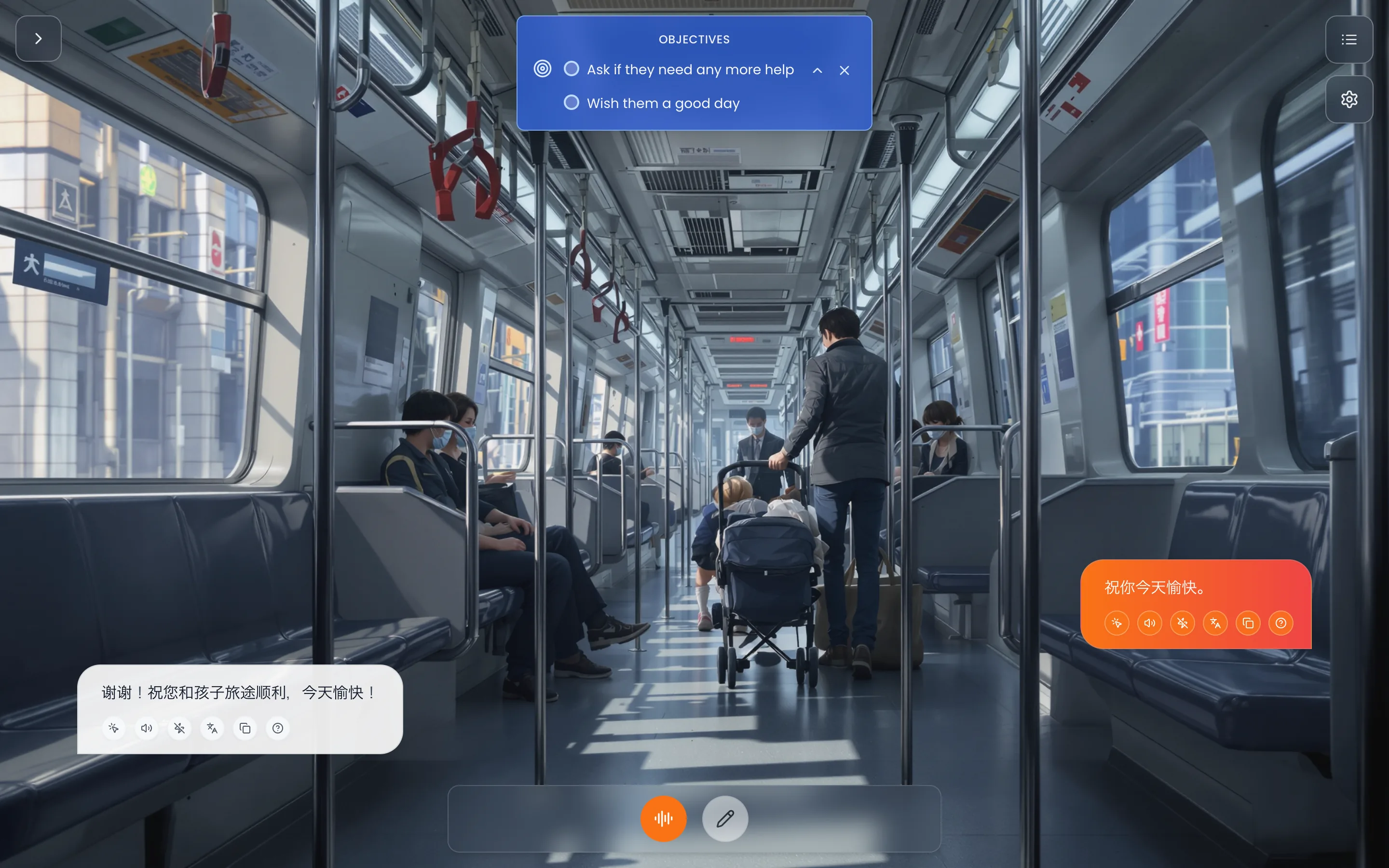


Practice with AI personas from around the world, or create your own.


Design a custom
conversation partner

Design a custom
conversation partner
Design a custom
conversation partner
Powerful tools that work together to accelerate your language learning journey
Stumble on a character mid-conversation? Tap to get the meaning, pinyin pronunciation, and example sentences — no separate dictionary app needed.

Instant clarity on your growth, no guessing, no hoping. See real proof that every minute you speak moves you closer to fluency.

Save Chinese characters, words, and phrases from your conversations and watch your Mandarin vocabulary grow. Export to Anki or any flashcard app when you're ready.

Stuck mid-sentence? Switch languages instantly and get corrections that keep you moving, no pressure, no breaking your flow.

All Chinese characters are annotated with pinyin so you can follow along and improve your pronunciation and reading skills.

See how learners practice speaking Chinese naturally — getting real-time corrections, vocabulary help, and building confidence with every exchange
Start speaking Chinese today
Try Nora for freeSee how Nora outperforms traditional and digital language learning alternatives
Swipe left and right to compare
Swipe| Feature | NORA | Private tutor | Other AI tutors | ChatGPT | Duolingo |
|---|---|---|---|---|---|
| Cost | $ | $$$ | $ | $ | $ |
| True bilingual support | Limited | ||||
| Instant vocabulary help | |||||
| Tracks your speaking progress | Varies | ||||
| Real-time voice call mode | Varies | ||||
| Create your own AI tutor persona | |||||
| Pronunciation coaching as you speak | Varies | Limited | |||
| Interactive stories |
Start with a 7-day free trial. Cancel anytime. Instant access to all features.
Billed $119.88/year · Less than $0.33/day
Both plans include a 7-day free trial. Cancel anytime.
- Mila, Israel
- Omar, USA
- Klara, Norway
- Alex, Greece
- Akari, Sweden
- Seb, Germany
Our approach is grounded in decades of language acquisition research
“Producing language (output) forces learners to process language more deeply than input alone.”
Merrill Swain (1995)
Three functions of output in second language learning
“We acquire language when we understand messages — comprehensible input is the essential ingredient for language acquisition.”
Stephen Krashen (1982)
Principles and Practice in Second Language Acquisition
“Conversational interaction facilitates second language acquisition through negotiation of meaning.”
Michael Long (1996)
The role of the linguistic environment in second language acquisition
“Words are better retained when the learning task requires higher cognitive involvement — speaking demands more involvement than passive reading.”
Jan Hulstijn (2001)
Intentional and incidental second language vocabulary learning
“Tasks that require meaningful communication lead to more effective language acquisition than form-focused exercises.”
Rod Ellis (2003)
Task-based Language Learning and Teaching
“Explicit feedback during interaction significantly improves second language development.”
Lourdes Ortega (2009)
Understanding Second Language Acquisition
“Learners must consciously notice features in the input for it to become intake — active engagement is essential for acquisition.”
Richard Schmidt (1990)
The role of consciousness in second language learning
From the blog
Deep dives into speaking, immersion, and what the science of language learning actually says. Real citations, honest takes.

Input builds understanding. Speaking builds fluency. Here’s when an AI language tutor helps, and when you’re better off just getting more comprehensible input.
August 6, 2026 · 9 min read

A clear-eyed guide to what an AI Spanish tutor actually handles well—correction, level adjustment, conversation reps—and where it falls short, from real input to human nuance.
August 6, 2026 · 9 min read

Japanese AI can help with parsing native text, clarifying audio, and giving you low-stakes speaking reps. It can’t replace immersion, but used well, it removes friction where learners usually stall.
August 6, 2026 · 7 min read
Practice conversations in 8 languages with Nora
Get the latest updates, tips, and exclusive offers delivered to your inbox
We send nice email updates once in a while